This is the first of 11 weeks of Teaching Experiments which we are also sending out on Saturdays to our mailing list. If you would like to receive these in email form please send us a message to Teachings@MarshaSummers.com with SUBSCRIBE as the subject.
Life’s Word Workshop – Lake Whitney, TX – 1981
There is a beautiful little book entitled
Life’s Word by Anonymous
(available at http://www.goodleather.com/bookspg4.htm)
Dr. Bob was asked to comment on the material for clarification. It has been transcribed verbatim, in the vernacular of Dr. Bob’s “Kentucky-ese”.
(Note: Audience comments are in parenthesis.)
[Dr. Bob’s comments within his reading of Life’s Word are in brackets.]
[Clarifications and Suggested Links to Illustrations on www.marshasummers.com are in brackets and italicized.]
Now I was requested by Marcy and by a few other people to talk on Life’s Word. That’s a little book that we’ve put out. I have it printed. It has no author’s name on it except Life. And I have always resisted talking on the book, because I thought everybody could just go ahead and read it. But in as much as it was requested, and it makes it very easy for me, and I’m lazy, I will talk on Life’s Word today. And if you can stand it tonight, we’ll continue on it tomorrow. Is that all right? And if you don’t like it, why, say so and we’ll quit. Now the only way I know to talk about it is somewhat read it and point out some of the things, as I understand it, what it refers to. Now, I’m going to read it with simple, everyday, modern, pseudo English. It’s written in very high-soundin’ “thee’s” and “thou’s” and “thy’s” and all that stuff and I can’t hack that, so I will just stick to “you” and “me” and etc.
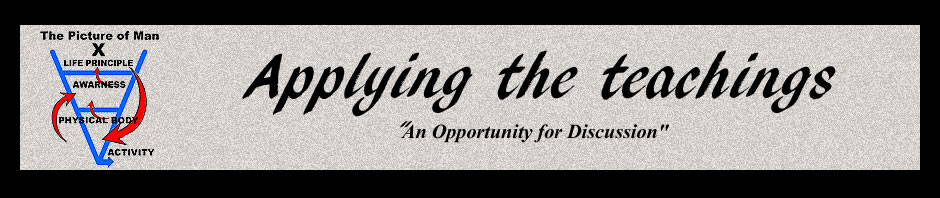
I’m going to draw a little picture [See Picture of Man in Illustrations] here which you have seen somewheres along if you’ve been here before. That here is a Physical Body, which seems to be a very essential thing for people to get along with. And in here is an Awareness. Some people call that “mind”. I do not. And somethin’ here that we will call Life and we will refer to it with the letter “X”. When I went to school a long time ago, they told me that in algebra, that if you knew somethin’ existed and didn’t know what it was, you put an “X” there. So, I know that somethin’ exists, but I don’t know what it is, so we’ll put an “X”. And there’s always some Function of a human being, is always makin’ some function. So we’re going to talk about this and I may point to it ever now and then from out of Life’s Word. Now, if you don’t like the way we do this, by reading about it and comments on it, which is the only way I know to do what Miss Marcy requested. And you know, what Marcy requests, Marcy gets. Doesn’t she, Bob? Did he leave already? (laughter) So at any rate, we will proceed with it on that basis. So I had one in my pocket, and so this one here can still be sold. I happened to find one in my pocket. Incidentally, we have a new edition of it that we had printed in Canada and it’s in beautiful, blue and white print. It’s in color and a slick finish. Do you have any of those down there, Marcy? Well, order ‘em, Donna. They cost more, but they’re worth more cause they’re pretty. They have the same words in ‘em, understand, but it’s been newly typeset and published in a very deluxe edition, to which everybody could have one and I think the price went up, less than the inflation rate. Ok? I told Donna when she called me to see if I’d come here, that I couldn’t come for what she used to charge. Because inflation’s gone up. The airplane tickets have gone up and ever other thing has gone up. Parkin’s gone up, gasoline to get down to the airport went up, so we finally negotiated and I let her talk me out of most of it but not quite all. (laughter) And from now on, we’re really gonna hang it on, you know… we’re really gonna get with it the next time. So you got the bargain this time. So we’ll start with Life’s Word.
I
First Mystery: Thou art I, Myself!
It starts off and says –
I am Life.
So the writer of this little booklet, book claims to be Life. Who are we to find fault with it?
I live in all bodies inspiring them always to do My will.
Now, frequently I hear people say, “If I only knew the Lord’s will, I’d do it – if He’d just let me in on it.” And seems He says, “I already got you doing it,” so you don’t have to worry about that one anymore.
This book eliminates all worry and concern if you take it a little seriously. It really gets all these things that we fret and worry about and make so important – our “evolvement” and our “enlightenment” and our “gettin’ with it”, and all this stuff – it gets rid of it.
I inspire this message, which is for those only who can receive it.
Now, of course, that’s all of us. Now, we may receive it slightly different, but we’ll hear something, somewhere through the thing – I’ll guarantee you’ll hear something – and that something is plenty. You don’t have to get ever word. In fact if you only get one of them, you’ll do quite fine. It says –
I know all Mysteries. That which I send has a hiddenor inward meaning for you. If your inward heart does not see the wondrous truth, be sure the brain mistaketh the meaning.
Now, the word “thy” is used all along through this little book, and “thy” has been understood by many people to refer to as a pronoun. But it is the word “the” – t-h-e. I believe it’s pronounced these days as “the”, is that correct? I never have been able to get it that way. I have a hard enough time with “the”.
… be sure the brain mistaketh the meaning.
And it does that by interpreting accordin’ to its preconceived opinions or frame of reference.
Think not that Life’s Word is of no interest. If the body thrills when touched by earthly joys, how much more will it thrill to the touch of that which is Heavenly! If the blood flows quicker and the tears spring forth when earthly emotions quicken you, how deep and strong shall be the current when I put Mine own hand on the heart!
Now, uh, Life deals with awareness. This thing we put as “Awareness” is, in this little book, called “heart.” Now, it doesn’t refer to that little pumpin’ piece of meat in our chest. It refers to one’s, what one does as being aware, is called the heart. And the heart is what determines what will be done. If you say, “I’m going to stand up,” why the heart has determined that, and you stand up. Now, you don’t know how to stand up. I don’t think. I’ve noticed that most people think they push up from their feet, but I’ve observed that you’re pulled up by your head just far enough to reach the ground. I think that’s the way it works. Try it and see if you can get up without tightenin’ up your neck. Anybody wanna try that, Mack? See if you can get up with your neck relaxed.
(No, I don’t care to try it.)
So you see, your head pulls that long carcass up ‘til it’s straight up and down above the ground; and you don’t know “how” to do it. You only determine “what”. Now, the heart says “what”. X takes care of the “how”. Now, don’t jump that in that you decided what you wanted was a new Rolls Royce and you figure that X will buy it for you. I’ve noticed it is really not interested whether you have a Rolls or not.
Fear not Life’s word.
Now, I’ve had a lot of people that say, “That thing just scares me to death.” Well, don’t read it, you know, why bother with it? Nobody told you, you had to read it. I just make it available. If it frightens you, lay it down.
Fear not Life’s Word. It will strip you bare of the complacency. It will destroy the self-righteousness. It will show you that you have always condemned Me unknowingly.
That’s Life.
And it will humiliate you to the dust. Yet fear it not for you are Mine. Unto Myself I have taken you, though you do not know it.
So we wouldn’t be here. We wouldn’t be doing anything unless Life had decided it. Now we think, “Well, I decided to go out to Lake Whitney for the weekend,” but you know, there’s a lot of things you decided to do didn’t happen very well. So Life says, “Well, you can profit from this, so you will get involved in it in some way or other.” So you got here.
Fear is a lack of trust [a trust in Life].
You know that’s what everybody fears, is that Life don’t know what to do. Is that right, Mary? You know, you figure little old Mary’s got to figure it all out; but really, you don’t have to know what to eat. Life’ll tell you you’re hungry for peanut butter and you get peanut butter. After a while it tells you you’re hungry for biscuit and sausage and you get that. And after a while it says a little shot of grits would be pretty good and so on. So it tells you and you don’t have to figure all that stuff out.
Fear is lack of trust. If you do not trust Me [Life], whom will you trust?
Used car dealers, I heard.
Will you put the trust in father or mother or brother or sister?
You know, we sometimes think maybe the relatives will take care of us, but I’m gettin’ along all right without relatives. I had some once, but they didn’t help much, so I departed, you know. I don’t think I have any anymore.
These too, do My will, however selfishly they seem to act toward you. Have you found that they betray the confidence that you put in them? That they expect of you
that which you cannot give?
You know, a lot of folks expected an awful lot of you that you didn’t seem to deliver; and you got very upset and so you felt, “I just can’t please people,” or “They’re very difficult to please.” Or some folks even go so far as to feel guilty cause they can’t please everybody. Of course none of us, I’m sure, ever did that. You wouldn’t do that, would you, Beth? Feel guilty because you didn’t please everbody? Not me, huh?
(I lie.)
You lie well too, Beth, don’t you? I noticed that.
Blame them not. They are My ministers to bring you unto Myself in perfect surrender.
Now, surrender doesn’t mean to become an abject nothing. Surrender means that I have ceased to know what ought to be. Now, that’s a pretty hard thing to give up, you know, because we are experts in knowing what ought to be. “I know how you oughta behave and how you oughta behave and how you should do everything and, whatever.” But you know if that could be given up, it’s called “surrender” which means possibly the things that we feel we are most rich with is: “I know what ought to be”, “I know how you ought to behave, I know what you ought to do.” You know… I really don’t. And I don’t even know what I ought to do. But let’s say that we could give up thinking we know what ought to be, and we could live quite contentedly with “what is.” It’s been pretty nice so far, hasn’t it, Mack? Huh? Well, it is when you wasn’t comparing it to what you knew ought to be. Now, if I compare “what ought to be” with “what is”, it comes out in a mess right now, doesn’t it? Hmm? Right now it should be cooler, the air-conditioner should be more cool in here. Uh… people ought to be leaving $1,000 apiece to come here tonight. Marcy, it would help pay the bills, wouldn’t it? You know, that’s some of the things that ought to be, but that’s not what is.
Now, when I compare “what is” with what I think it “ought to be’, “what is” comes out looking pretty shoddy. Is that right? Hmm? And if I don’t compare it to anything, I’m simply enjoying it, isn’t it utterly amazing?
I work with a guy who says, “It’s amazioney, that’s what it is.” So it’s really amazing that we can walk and see and hear and touch and speak to each other, and be aware of what’s going on around us, and just simply being alive. That is very amazing. But if I know what ought to be, I’m in a pitiful shape, aren’t I? Hmm? Real bad. I can feel so sorry for myself. And very justifiably too. So we’ll leave that one; that’s surrender.
You need not worship Me. [Period.] In the heart there is that which is one with Me.
In other words, there’s a little bit of I in here which is one with X. It is that which says “what” without making a judgment about it or anything. I’d draw a line under that there. And then there’s another kind of “I” we put out here with little quotations marks around it, which is the false ones.
You need not worship Me. In the heart there is that which is one with Me.
Now, you certainly don’t have to worship something that’s one with you. You don’t have to worship a toe, or a foot. Now, I’m very thankful that thing’s down there, but I don’t worship it.
But if you do sincerely worship any God or any godlike man or anything of heaven, earth or hell, then you do unknowingly worship Me.
So if you worship anything, even money, it says you are worshiping “Me” because you know the whole thing’s made – there isn’t anything else anyway.
Have you an ideal? I am that. Have you a love? I am that.
That’s really what you care about.
You need not believe Life’s word.
You don’t have to believe a thing in this book.
You shall feel in the heart that I am there, but I have given you also a brain to question, and to analyze, and deny. Fear not to use it.
In other words, challenge everything. You know, there’s nothing more unspiritual than to be gullible. That is sometimes called “faith”. You know, you just believe somethin’ because some joker stood up and talked loud and clear and said it, or you found it written in a book. And after all, everything in a book has to be true – you know that, don’t you?
So there’s nothing more holy than to question and challenge, because that’s the only way you’re really gonna ever find out anything. Period. Not by bein’ gullible. If you just believe something because somebody you chose to look at it as an authority said it, or some book you was told was an authoritative book, you’re just bein’ gullible, not spiritual. And let’s don’t call that faith; let’s just call that what it is – bein’ gullible. Most of us have a large supply of it. That makes us pretty sitting ducks for about everthing comes along.
You need not believe Life’s word. You shall feel in the heart that I am there, but I have given you also a brain to question and to analyze and deny.
Please use it.
Fear not to use it for I have sanctioned its power
both to question and to analyze and also even to deny.
Cause sometimes you can’t ever figure out anything and you have to start over a little bit.
You will be told that I am all-powerful and always cause My will to be done. Whether the thought comes to you to penetrate into the Holy mysteries of My revelation, or that other impulse comes to you to refuse or neglect My message, know that both of these are from Me and are sent unto you in order that you may be called by that one
which appeals to you the strongest.
So something in here (through the next day while we work on this) will appeal to you very strongly. Now, I hope not all of it does, because that would look a little bit gullible. But there will be some phrase – one of the mysteries in here – that will appeal to you. I have been through this a number of times and there’s one that appeals to me, and it is the only one that really appeals to me, but it takes care of everything else. I don’t need to bother with the rest of it. That makes all of it straight and nice.
So, one of ‘em’s going to be strong. If you listen along here and there, it will hit you in the head; and then we can all go home as soon as the last one got hit. You know, we can all take off then because we won’t have to go fiddlin’ along. Let me know when the last one gets done.
If the thought comes unto you that this message is not inspired of Me,
Maybe some joker just wrote it some night or whatever.
then be sure that it is not for you as being the message of authority.
And I hope it’s not a message of authority to anyone. Because if it’s accepted as an authority, you would either have to make me an authority or the printed page; and I’ll guarantee you neither one are. So let’s leave all the authority “bit” off and that’s what is said back here – deny it, challenge it, question, analyze it – do anything you want to, but don’t just take it on.
But it is for you just as you see it. If you are filled with wrath that My authority be claimed for all that is done, know that such wrath also is Divine and that I inspire it in the heart and make it serve My will.
Nothin’ wrong with bein’ wrathful every once in a while. You say, “Why, that is the most damnable mess of stuff I ever heard! It’s against every religious principle I ever heard. It’s against ever spiritual teaching.” Hang in there, hang on; that’s the way he wants you.
My authority is a claim for all that is done. Know that such wrath also is divine; and that I inspire it in the heart and make it serve My will.
So just let it sit there.
I do all things well, and it shall be well for you
if you can take this message as being of no authority…
It may throw an idea out, but don’t take it as an authority and say, “Man, I gotta believe that!” Because, phht—terrible!
…except as My voice in your own heart speaks.
So if you hear something and it hits you, it’s all right.
In all writings, all speech and all language there is no voice but Mine.
Do you suppose that if there wasn’t Life in one of these bodies here tonight, any one of ‘em could say one word? Did you ever see a corpse start talking? If you do, I’ll run. Did you? So Life is the only thing that can talk. So, remember Life is doing the talkin’, not a person, and not a personality or anything. So…
In all writings and all speech and all language there is no voice but Mine.
says Life.
That which calls you not is no voice at all. But that which calls you, whether it be bold, or to surrender, is My voice alone.
So, it sometimes tell you to fight and sometimes it might say surrender; but if it does, that’s Life.
I live and love in the body.
Now the body would not be alive if X, Spirit, whatever we choose to call it, is not there. We then have a relic left on our hands, a dead body, huh? So if it’s there, that’s what’s running the thing.
I live and love in the body. When you say “I am” or “I love”, then that is Me speaking. When you say, “I have”, or “I want”, or “I believe”,
then that is the self-consciousness speaking for itself.
Now we’ve talked about not-I’s, as lack of a better word to refer to, that this one here [See ‘Picture of Man’ in Illustrations section] says, “the whole purpose of living is to be non-disturbed.” I’m not goin’ through those. And this one says, “complain” and this one, “stick up for rights” and this one, “blame”, and this one says, “please everybody”. This one says, “quote the proper authority”, and this one says, “you’ve gotta improve yourself”. Now that is called the “personality” or the “self-consciousness” speaking for itself. It is not I – it is not Life at all; and so most bodies are operated by personality, not by Life. However, Life does kinda balance things up and keeps things going in spite of all this stuff.
And behold the self-consciousness shall die with its possessions and desires and beliefs; but I am undying forever.
Says life. Now it says that these things here will die. And the personality made up out of complainin’, stickin’ up for rights, blaming, pleasin’ people, tryin’ to quote proper authorities, improving self, and knowing that the Four Dual Basic Urges [See Illustration section] are the whole purpose of living. The Four Dual Basic Urges are the desire to have total comfort – physical, mental, emotional, and psychically, and otherwise and to escape the other one. So it is trying to gain physical comfort, attention, approval, and a sense of being important; and it wants to escape physical pain and the pain of being ignored or rejected or disapproved of. Now, if anybody wants to check out what personality is doing, it’s not very difficult to see if the greatest amount of time and effort isn’t spent on that little chore. Would that be about right, Miss Mary? Tryin’ to gain physical comfort, to get attention, approval?
You know, I have people call me up and say, “I only slept an hour last night. It was so horrible and I tried all night to get to sleep.” Well does anybody here know how to get to sleep? If you do, you got somethin’ to sell. You know how to get to sleep or do you just drop off to sleep and after awhile you wake up? You know when you’re tryin’ to go to sleep, you can’t. When you’re trying to digest your food, you don’t do very well at it. When you’re trying to keep your heart running regularly, it jumps all over the place. And if you’re trying to be very comfortable, you’ll find a jillion little itches, a little tension here, a little pull there. You better turn this way and you better turn that way. Heavy, you know, it’s just heavy. So I tell a lot of folks that come in to visit me, that no self-respectin’ body will work well while being spied on. And I’d like for you to kind of put that down in your little notebooks somewheres that, “No self-respecting body will work well while being spied on.” Now we’ll even further extend that. “No self-respecting Awareness will work well while being spied on.” And Spirit says, “You spy on me, I’m long gone.”
So, uh, you can’t very well spy on things, and if you also notice some day, when you have nothing else to do, that all your sensory organs are directed to the outside. You hear sound waves from outside – thank goodness you don’t hear what’s rattling in your head unless you become psychotic. You don’t smell your breath and everthing; you smell other things from the outside. You don’t hear things rattlin’. You don’t see inside; you see things on the outside. So if you notice all the sensory organs – touch, taste, smell, hearing, etc. – all turned outward. And when you turn ‘em around and try to feel of what’s going on inside, you become in a very anxious state – very anxious. So I would like to suggest if anybody wants to check this out, that tonight when you go to bed, you try to get to sleep in one minute. Don’t fiddle around there and just let it fall in and happen after a while. You really get with it and force yourself to sleep with willpower and strength and knowledge, will you please? (laughter) And you’ll all go to sleep about 9:30 in the mornin’ and we don’t have to work tomorrow, while you sleep all day.
You have a body, but you are not the body.
You’re not the body.
You have a consciousness of self-existence, but you are not the consciousness. What then are you? Body you are not, consciousness you are not – you cannot tell what you are!
Isn’t that just about right? You know, I have people come in and they say, “My body hurts me. My mind’s driving me crazy. And I have to save my soul and I have to watch everything I do.” Now, what is there left over? What’s sayin’ “I” there? There isn’t anything left. What would you think it might be, after all that, that you claim you own? You’ve heard those phrases haven’t you: “My mind, my body, my soul, my spirit, my past, my future,” and all these things? Now do you own all that stuff. “My symptoms” – don’t forget those. “All my symptoms.” Organ recitals people give. (laughter) They go through organ after organ – “the liver don’t work well, the heart’s not good, my diaphragm’s stuck, my stomach’s slow, my knee is not working well, my skin breaks out.” You know, it’s one organ after another you hear about. So when you go through all this, what’s left over to do the claiming?
So really what most people conceive of themselves, is a verbal device to avoid responsibility. You see “if my body hurts me,” I’m not responsible. “My mind’s drivin’ me nuts.” I’m not responsible for that – the mind’s doin’ it. “My body hurts me, my thoughts kept me awake all night last night. See I’m just not responsible at all, am I?” Hmm? Isn’t anything there to be responsible. Nothing there to take charge.
So unless we can conceive that I means whatever Life is, we can get the sense of awareness situated in X, not in one of these things, or this, or this out here, you know. “I’m a cowboy.” That’s my function. That don’t mean any thing. So if I can see that I am an expression of Life, and I am responsible for choosing what I will do. About right, isn’t it? Hmm? You couldn’t say, “Well, my hand just hauled off and bopped her,” could you? Mmm? I’ve heard people say it did. You know, it’s like when we drop a cup, we say the cup slipped out of my hand. You know, the damn cup did it – anybody can see that. I didn’t have nothin’ to do with it. And cars do a lot of things you know. They go out of control. (laughter) Did you ever hear about that? Did you ever see a car just run and get out of control? Does your 280 ZX ever wander off and get out of control? It’s liable to some of these days, isn’t it?
And isn’t it wonderful to hear about “my emotions got all out of control last night,” hmm? Who do they belong to? Crap, you don’t own any emotions. They’re just things that happen when you’re not in charge, that right? But you can blame those emotions for doin’ things to you, can’t you? Did you ever say “my temper just run away with me,” hmm? Did you ever do that, Beth? “My temper is just uncontrollable.” You know it ordinarily has a little chain on it or a little leash or a collar. I guess it’s like Bekki’s dog. It’s got a rhinestone collar, but ever once in a while, you drop the chain or the collar breaks and then it takes off. Isn’t that marvelous? Man…
You are I, myself!
It says in big, bold capital letters here. “You are I, myself.” That’s what’s really doin’ the talking. X is the only thing that can talk; the rest of it is just rattling around there.
You are one with Me.
Now that is something that maybe we could conceive of as a big principle, but we haven’t experienced it, so don’t try to experience somethin’ just goin’ around and mouthing it off because you’ve seen the fundamental principle of it. It’s laid out here. “You are I, myself,” says Life. “You are one with me.”
Yes, you are that, are God of Gods, Creator of Worlds, the beginning and the ending, the All-power, the triune glory of Life, truth and love…
Boy what pretty words.
…which you have been designed to make the body Its habitation. The body is My temple wherein I dwell, and through which I express My will.
Now doesn’t Life dwell within the body? And we’ve all seen bodies without Life in ‘em and we get very pious and say, “Here lies the remains.” We’re very holy about it. We don’t think much’a Life. But what’s left over we get very touchy about. We get very sentimental over carcasses and dead bodies, but we don’t seem to really realize that, “Look, I’m talkin’ to Life there.” I’m lookin’ at Life here. I’m speakin’ to Life. I love Life. I appreciate it and everything. We don’t see that, but boy, we really get very pious and drop everything and go see a dead body, don’t we. Isn’t that funny? You ever done that, you know? Just dropped your business and household things and everything and took off to some parts because there was a dead body over there somewheres?
Mama used to drag me to those things, but I haven’t been to one under my own will power except once; and they asked me to say a word over him. So I went and said, “Well, old Harry left us a little chore: get rid of the remains. Let’s get it done and go home.” (laughter) And the undertaker got very upset because he was all set for tears and all this stuff. He kept tryin’ to get to them, and I said, “Look, man, we’re paying you, let’s get this job done that Harry left us to do.” So he grabbed up a rose and went and put it on old Harry’s wife who hadn’t spoke to him for five years without screeching at him, and he tried to get her all wound up. And I went and took the rose and said, “Let’s get it over with!” and he finally understood me. And we’d hired him and let’s get old Harry’s remains in the ground – that’s what he left us to do. So. That was the shortest funeral presentation in all history: “Let’s get it over with. Harry said get rid of this. That’s what he left us to do – what he couldn’t do for himself.”
In due season thou shall feel the ever present “I am” and “I love” in the heart, then you will know that you are Mine. That the mouth speaks My voice, that the heart beats with divine impulse and that I live in you.
Now a great teacher many years ago that we’ve all read about said, “The Father and I are one.” Now they got a little commotion started and they nailed him to a tree for makin’ a foolish statement like that because nobody could understand it. And of course, I wouldn’t suggest you go out and say it today. They won’t nail you to a tree, but they have places where they lock you up or give you some very powerful drugs so you forget foolishness like that, real quick. But don’t mind to be aware of it if it should ever be aware to you. But you don’t have to run around and tell everybody. It’s dangerous.
In due season that you feel the ever present “I am”, and “I love” in the heart, then you shall know that you are Mine. That the mouth speaks My voice, that the heart beats with divine impulse, and that I live in you.
This body. And that is one of the greatest things I think that one can come up and realize, and as far as I’m concerned, it eliminates all troubles in the world. Now, I didn’t say ‘challenges” ‘cause Life is full of challenges.
If you go out and look in the desert, you’ll see a tree growing up against rocks. You see it growing in sand piles. You see it growing through brambles. You see things that really looks like they have no chance of bein’ there. But Life has all these challenges. But, you know I’ve never seen one of those little cactuses or those little desert trees complaining about how hard it is to get along: “We’ve only had three inches of rain this year.” Did you ever hear one of those little plants crying and moanin’ and feelin’ sorry for itself and trying to sell you on how unfortunate it was? Have you ever had that, Mary? Huh? Did you ever see a little dandelion moanin’ because the wind was going to blow its beautiful hair away, hmm? Or that somebody was gonna run over it with a lawn mower? You know if you do… Did you ever run over a dandelion with a lawn mower? They beat you back up ‘fore mornin’. Did you ever cut crabgrass? Oh man.
So Life will have its challenges, but once you see what you really are, then you will not have troubles. Now, most people here have troubles. That right, Beth? You’ve had your lots of troubles. I talked to an old man one time many years ago when I was rattlin’ off some of this stuff I talk about. And he said, “Say, Bob… what you’re really saying is what I finally caught on to the other day. I’m a very old man and I’ve lived a very long time, and I’ve had an awful lot of trouble – damn little of which ever happened.”
Now has most of the trouble you’ve ever had ever happen, or did you just worry that it was going to? Did you ever starve, Mary? Did you ever worry that you would be totally without funds, have no way to eat and sleep, thrown out on the street cold and hungry like the poor little match girl of Baghdad – no friends, no cares, nobody to care for you? We’ve all had those kind of troubles, haven’t we, more or less? Except for Miss Monroe back here – she don’t have it. I think she did once, but she forgot about it. You had that once when you was a kid, didn’t you?
Perhaps you think now that you are a separate soul, but hereafter you shall see the heavens opened into the heart and then you shall see that I and I alone exist.
Now if there wasn’t any Life, there wouldn’t be anything existin’. There may be a bunch of mud balls floatin’ around, but there wouldn’t be anything to be aware of it, would it? So Life is the only thing that can be aware of anything. So it’s the only thing that can really does, can say, “I exist”, is Life. The rocks and all that don’t do that.
And that there is no other soul or spirit but Me.
Life is what we’re all talkin’ about. Now you may use all kinds of other words, but even the Scripture that some of us read once in a while says, “God is Life.” So we take that kinda lightly. We forget all about it, but nevertheless as we look around, we’ll see that that is what is going on. And talk about miraculous things It does – just study it.
We’re writing a little book called “The Magic Book”; and the “Magic Book” takes on some of the things that Life does. Now, would you think it was a magical stunt if I could take a ham sandwich and a glass of milk and hit it with my little magic wand and make a human finger out of it? You’d think that’s a pretty good stunt, wouldn’t you?
(Yes.)
Life does it every day, and we take it for granted – totally unconcerned. We eat it up and it makes human flesh and blood in a matter of hours. No labs or anything else can do that – even the people with genetic tinkerin’ can’t do it. So there’s only one thing that really exists that matters, and that is Life.
Do you say, “Is there none but God?”
That’s the question.
Then who am I?
Then you say it no more for this Mystery shall be revealed unto you.
That is called the First Mystery. The mystery will be you’re not going to force it, you’re not going to make it happen, you are not going to do anything to fudge it over or anything. It is simply going to be one day you’re aware that Life is “what is.” And that Life is a mystery beyond all comprehension, but that you can be aware that you are Life; and I still say from there on you have no problems. I did not say you wouldn’t have challenges. I didn’t say the wind wouldn’t blow cold on you some day and that you’d be uncomfortable. I didn’t say you wouldn’t stump your toe on a rock and hurt your toenail. I didn’t say you wouldn’t get sunburned or anything, but you would be quite content for that to be cause Life goes on and takes care of all those things very, very nicely.
It’s only when the person is operated by this non-I that says the whole purpose of living is to be totally non-disturbed at every minute, then we’re not content to have any disturbance. But you know that’s not so necessary because nothing thrives well unless it has a bit of resistance. We say there is four different forces goin’ around – they all work together as one. There is “Initiative”, “Resistance”, “Form” and “Result” and they all go to make up any completed phenomenon. [See The Four Forces in Illustration Section] Without any resistance, you don’t get much. If you planted a bean seed in a pot on the porch and kept it just damp and everything, it will grow a sprout, but you’ll never get a bean plant because it has no resistance. You’ll just get a bean sprout and it’ll fizzle out before very long. It dies because there is no resistance. If there’s no resistance to anything, it comes to a screamin’ halt before very long, ok? That right?
So can we be simply that “Life is” and that I’m quite content with it like it is. I’m not gripin’ and so forth (I use the word called “gritchin’” – that keeps me from sayin’ all the rest of it) because everything isn’t just like I want it. Or am I quite capable of seeing that Life makes everything run along? It’s been running this situation called planet Earth with Life on it for innumerable number of years that we don’t know anything about. And who are you and I to come up and say we can straighten it all out like it ought to be, right quick? I’ve noticed that all the people who try to straighten it out sure make messes. It takes even Life a long time to get it straightened out after that.
Ok, we’ve been talkin’ for about an hour. Marcy, do we go one more tonight or is one enough tonight and start from there? Donna?
(Whatever you feel up to.)
Well, I always feel up. I can talk all night but I’m not goin’ to, but what is your usual arrangement? It’s nine-thirty. Want another session? Take a five minute break and start over again? Ok, we’ll have a five minute break and we will continue.